
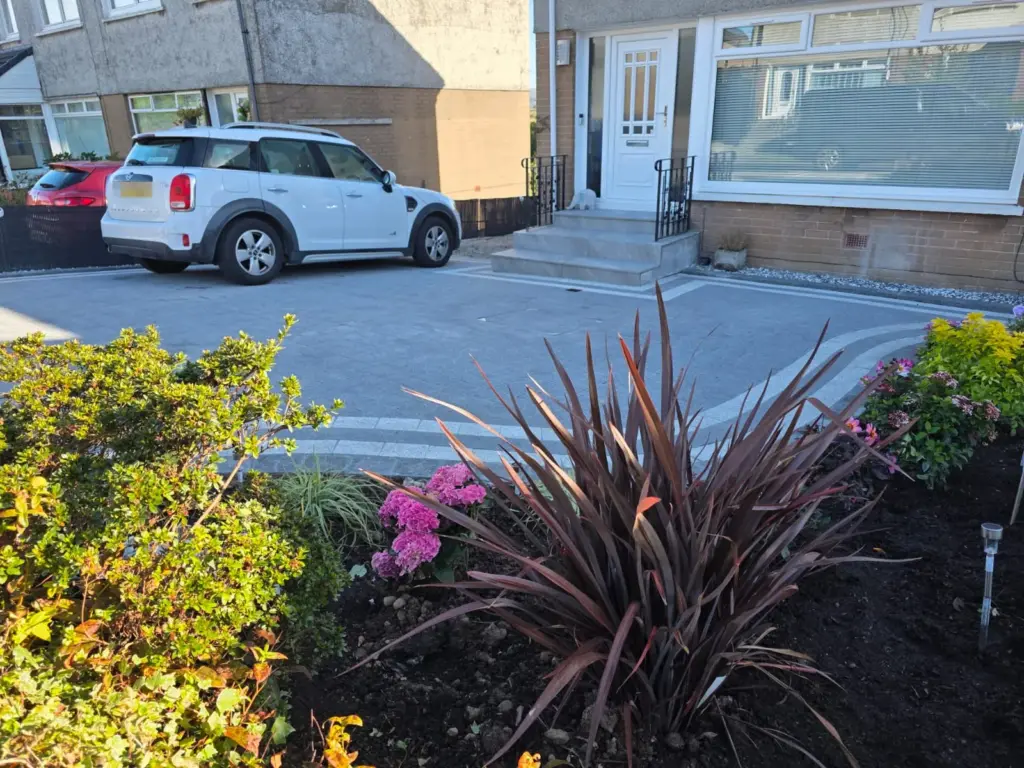
Monobloc (concrete block paving) is the most popular choice in Scotland. It comes in a wide range of colours and patterns, is easy to repair and usually costs less to lay. Granite setts are natural stone: exceptionally hard-wearing, with a traditional look, but they take more labour.
Plenty of driveways use both, with monobloc in the main area and setts for borders or the apron.
| Monobloc | Granite setts | |
|---|---|---|
| Material | Concrete blocks | Natural granite |
| Look | Even and neat, in a wide range of colours and patterns | Traditional, with natural tones and texture |
| Durability | Very good for a domestic driveway | Exceptionally hard-wearing |
| Colour over time | Can soften or fade gradually | Keeps its colour |
| Surface | Smooth and even | Slightly textured, with more grip |
| Repairs | Individual blocks lift out and relay | Can be relaid, but matching setts may be harder to source |
| Cost to lay | Usually lower | Usually higher, as it takes more labour |
A driveway is only as good as what is underneath it. Sinking, rutting and puddles are groundwork problems, whichever surface you choose.
In Scotland, a new front driveway usually doesn’t need planning permission as long as rainwater drains within your property rather than onto the road. We design every driveway with that in mind. See our driveways page for more.
Concrete block colours can soften gradually with sun and weather. Granite keeps its colour.
Traditional setts have a slightly textured surface. Sawn-top setts give a flatter finish if that matters to you.
Yes, and it is one of the most popular options: monobloc for the main area, with setts for borders, banding or the apron.
Usually not for a front driveway, provided rainwater drains within your property rather than onto the road.
Thinking about a new driveway? Call 01236 728098 or request a free quote.